
New APM research reveals ways to improve government project performance
Research published by Association for Project Management (APM) reveals new findings on why government projects succeed or fail, and what would improve project performance.
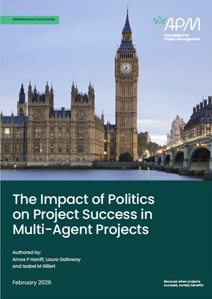
The Impact of Politics on Project Success in Multi-Agent Projects, written by Professor Amos P Haniff, Professor Laura Galloway and Isabel M Gillert, explores how political priorities, power shifts and cross-organisational tensions shape the outcomes of multi-agent projects in the UK. The research offers practical guidance for better project delivery, highlighting the importance of strong leadership, clear governance, skilled teams and effective incentives.
The study used a qualitative research approach based on in-depth interviews with senior public sector figures who had experience of national-level government projects. Participants included elected parliamentarians and senior civil servants from Scottish and UK government departments.
What did the research discover?
Government projects were found to fail for reasons including:
- Power dynamics: Political conflict, fragmented interests, shifting priorities, unclear funding, weak leadership
- Public service challenges: Frequent role changes, uneven skills, lack of incentives
- Project management issues: Poor planning, unclear objectives, limited training.
Government projects were found to succeed for reasons including:
- Strong leadership: Clear authority, political understanding, effective coordination, conflict resolution
- Collaborative communities: Cohesive, cross-departmental teams with shared goals
- Effective power use: Political consensus and depoliticised delivery.
Ways to improve government project performance include:
- Promoting cross-party collaboration and consensus
- Enhancing civil service skills, incentives, and leadership continuity
- Providing structured training on project management and governance.
Recommendations
As these UK public sector projects depend on collaboration between government, private and third-sector organisations for success, the research report offers several recommendations to help improve outcomes and public value, including:
- Strengthen leadership and accountability: Clarify roles, ensure governance, empower leaders
- Improve communication: Set clear roadmaps, maintain transparency, manage public and media perceptions
- Improve project capability: Provide structured training, adopt standardised methodologies, adopt learning practices
- Depoliticise delivery: Encourage bipartisan collaboration, use neutral mediation, protect teams from political pressures.
Gabriela Ramirez-Rivas, Research and Impact Advisor for APM, said: “The full research report is essential reading for anyone interested in learning why UK public sector projects fail or succeed. Not only does it highlight the complexities behind government project delivery, but it also offers actionable guidance and recommendations on how to improve project delivery. The full report goes far beyond this summary, offering deep insights and practical advice for success.”
0 comments
Log in to post a comment, or create an account if you don't have one already.