
From Beyoncé rehearsals to programme delivery: lessons from CoSTAR Live Lab

Programme Manager Glen Kelly tells the story of the state-of-the-art R&D facility for the UK’s live performance industry that is tucked away in Yorkshire town.
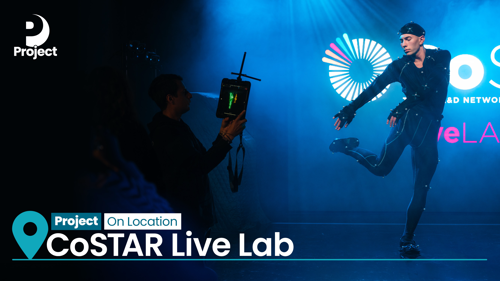
Image credit: Alex Holland
The boot was full of hot pink cushions as I pulled into the office car park on a Thursday night in January. I had been on my second trip to IKEA that week. In a few days, we’d be opening the doors to several hundred guests, among them mayors, vice-chancellors, BBC journalists and the musician Jamie Cullum, for the launch of the £75.6m CoSTAR Network. The cushions, for reasons that made sense at the time, mattered. I’m the Programme Manager for CoSTAR Live Lab, and that day, the job was all about soft furnishings.
CoSTAR Live Lab is a state-of-the-art R&D facility for the UK’s live performance industry. It’s a joint venture between the University of York and Production Park, Europe’s premier production destination for the entertainment industry. We’re part of a £75.6m national network set up to keep the UK at the forefront of innovation in the creative industries, and our focus is virtual production: applying the kind of technology you’d associate with film and games to live performance.
Where the stars rehearse
If you’ve not heard of Production Park, you’ve probably seen its work. It’s a 30-acre site in South Kirkby, a former mining town near Wakefield, which is not where you’d expect to find the rehearsal studios used by Beyoncé, Lady Gaga, Pink and Coldplay. The live productions that go out on the world’s biggest tours are built and tested there. Netflix filmed its award-winning show Adolescence on site. It’s where the final of ITV’s The Voice was recorded. It’s also home to the Academy of Live Technology, which trains the next generation of live event professionals and, from July 2026, will be able to award its own degrees.
What CoSTAR adds is research and development. Our lab is where people come to test new ways of making live performance, working with motion capture, spatial audio and virtual production, with a team of researchers and technicians in the building every day. We offer a range of fully funded support packages for UK businesses to develop, test and commercialise new technology for the creative sector. That might be through cash funding and dedicated access to our lab, or one-to-one mentorship from partners like Sony, Vodafone and Vicon. Most recently, we launched a £100,000 funding call for companies to test new concepts relating to ‘intelligent venues’ – adaptive environments that respond in real time to audiences to deliver a completely personalised and immersive experience. As a programme, we’re continuously managing a dynamic pipeline of commercial and academic stakeholders.
Hiding in plain sight
When most people outside the project profession picture a project, they tend to imagine a building site, a railway, an IT rollout or a digital transformation programme. They don’t picture a band in motion-capture suits (think Andy Serkis’s Gollum in The Lord of the Rings) performing on a virtual stage in Fortnite.
But the creative industries contributed £125bn to the UK economy in 2022, more than aerospace, automotive and the life sciences combined. It’s a vital part of the economy, it’s growing and it runs on projects. But where construction and IT have built up their own dedicated project management qualifications over decades, a comparatively modest number of people are trained specifically in the creative industries.
I came into it the same way I came into everything else – sideways. I’ve managed business support programmes, net zero initiatives and digital transformations. Now it’s motion capture and spatial audio. The thing tying all of that together is that I’ve never had deep technical expertise in those fields, which used to feel like something to apologise for, and now feels like the point.
Staying in your lane
In the majority of project management roles, we deal with people, money and time, whatever the subject matter. That holds whether you’re leading a team delivering a new CRM system or a virtual production facility. Early in my career, I thought I needed to understand the intricacies of the engineering to manage the engineers. I was wrong. At CoSTAR, I’m lucky to work with a team of absolute magicians daily – technicians and researchers who can blend physical and virtual worlds in real time.
If I spent my days trying to master the nuances of spatial audio or Unreal Engine, I would just be getting in their way. I proved this once when I ‘helped out’ by cabling up a set of speakers in the lab. I arrived the next morning to find our technician quietly taking it apart and redoing it properly – a gentle reminder to stay in my lane.
With a good team around you, not being the technical expert can be more of a superpower than a weakness. You manage the logistics, the resources, the strategy and the relationships, and you leave the specialist work to the specialists, who are far better at it than you’ll ever be. That only works if you’re honest about where your value actually sits, which brings me to the thing I’d most want to tell myself five years ago.
Busy ≠ valuable
When you join a new programme, spend the first few weeks listening – not just to the plan and the deliverables, but also to the issues and gaps. There’s almost always a contract that’s been stuck in negotiation for months, a governance process nobody owns or a supplier relationship that’s quietly soured. Make it your business to find one of those and unstick it. Nothing builds trust with a team faster than moving something that’s been perpetually stuck.
The flip side of that is learning what not to spend your time on. We’ve all known the person who spends days keeping the risk register immaculately colour-coded and the quarterly report formatted to the millimetre, while a key contact waits a week for a reply and a supplier proposal sits unreviewed. Being busy is not the same as being valuable. Pay attention to detail, but don’t let it run you. I write my priorities down every Monday morning and keep them open on OneNote (other note-taking applications are available) all week, because the small stuff has a way of quietly becoming the big stuff if you let it.
Like most project managers, I spent much of my early career as the youngest person in the room. Running large infrastructure projects in higher education, I’d sit in steering committees where the sponsor was a C-suite executive, a COO or similar, and I got into the habit of listening for the specific things they asked about. Where did their attention go? What did they keep coming back to? Then I’d go away and tighten exactly those areas in my next report. It put the sponsor at ease, and over time it taught me what someone at that level actually wants to know about a project, which is rarely the detail on the Gantt chart.
Stewardship, not delivery
That same habit does something more useful day-to-day. Once you understand what the wider organisation is reaching for, you start to spot where your own work can feed it. The University of York recently announced that it’s opening a campus in Mumbai and building partnerships across India, including a five-year agreement with the Indian Institute for Creative Technologies. CoSTAR is named directly in that plan, because a one-of-a-kind facility working in virtual production is exactly the kind of thing York can offer partners and students in a country with one of the world’s biggest film industries. None of that is in my job description. But knowing it shapes what I say yes to, and which opportunities we should push to the front of the queue.
As it stands, CoSTAR is scheduled to run until 2029 across several phases. We’ve come through mobilisation, building works, fit-out, equipment, recruitment and into delivery, with a full team in the lab every day working with industry. But ‘delivery’ undersells what the programme has become.
Our team is effectively running three things at once: the programme itself, the day-to-day operations of a working lab and the strategy for what happens after the initial funding ends.
The operations piece – service improvement, team development, the ordinary business of keeping a facility running – falls outside what most people would call programme management. So does the strategy. How do we make CoSTAR sustainable as a business unit for the University of York and Production Park beyond 2029? We’re testing new income streams like facility hire, consultancy and CPD courses that weren’t necessarily defined in the original scope, because strategy means answering the sustainability question now rather than in 2028.
The KPIs, the deliverables, the reporting and the governance are the floor of the role. Everything you build on top of that floor is where the job actually happens.
Where this goes next
CoSTAR is unusual, but I don’t think it’s a one-off. Fewer programmes now run to a clean endpoint and a tidy handover. More are expected to continuously deliver in line with a fluid organisational strategy, generate additional value and stand up something that carries on running long after the original team has moved on. The role keeps absorbing more: operations, commercial thinking, organisational strategy. If your own job has started drifting in those directions, I don’t think you’re doing it wrong. I think you’re part of a wider evolution in project and programme management.
So if you find yourself in a conversation on Monday about initiatives that stretch long beyond your project’s end date, or running around every furniture shop in Yorkshire looking for cushions in a brand-compliant shade of pink, you’re not the only one. Embrace the ambiguity and enjoy it. Even if nobody notices the cushions.
Check out the video from Project’s on-site visit to CoSTAR Live Lab
This is a free Project article. Browse more articles here. Not a paying member? Join today

0 comments
Log in to post a comment, or create an account if you don't have one already.