
Mental health, inclusion and sustainable delivery: A new leadership approach

Most project managers are good at spotting risk early. We scan for dependencies, stress-test schedules and build contingency into plans long before anything goes wrong. It’s what the job demands.
Yet there’s one category of risk that still tends to be dealt with late, awkwardly, or not at all: the human one.
Mental health, psychological safety and inclusion are often acknowledged in principle, then quietly pushed to the edges of delivery. They sit in policies, awareness sessions, or values statements, while the project itself carries on at full speed. When issues eventually surface – through absence, conflict, loss of confidence, or sudden attrition – leaders are forced into reactive decisions under pressure.
The problem isn’t indifference.
It’s that most project environments haven’t been designed to absorb human pressure in the same way they absorb technical or commercial risk.
That’s the gap the S.A.F.E.R.™+B model was created to address.
The framework, in plain terms
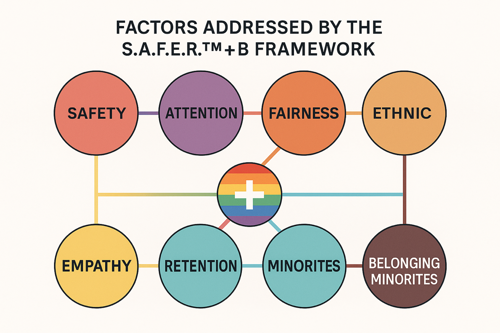
S.A.F.E.R.™+B brings together six areas leaders can actively influence:
- Safety – whether people feel able to speak honestly before problems escalate
- Access – whether unnecessary barriers are distorting contribution
- Function – whether roles and expectations are clear and workable
- Equity – whether decisions are fair in practice, not just on paper
- Recovery – whether capacity is treated as something that fluctuates over time
- Belonging – whether people can contribute without managing identity-based risk
These elements are shown together in Figure 2, which highlights that sustainable delivery sits at the centre of the model. None of the elements operate in isolation; weakness in one area tends to show up as pressure elsewhere.
Designing for pressure, not reacting to failure
In practice, organisations tend to approach mental health and inclusion in one of three ways.
Some respond reactively, stepping in only once someone is clearly struggling or performance has dropped. Others take a proactive approach, offering training, campaigns, or wellbeing initiatives alongside delivery. Both have value, but neither really changes how projects are run day to day.
A smaller number take a pre-active approach. They design work, roles and expectations on the assumption that pressure, difference and fluctuation are normal – not exceptional.
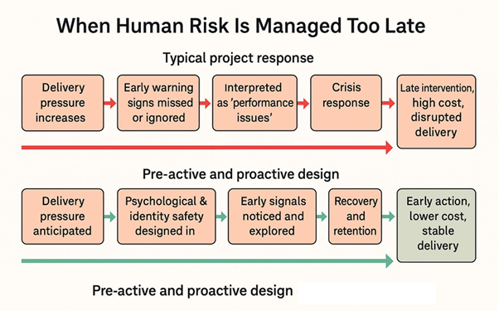
This difference is illustrated in Figure 1, which contrasts the familiar late-stage escalation many projects experience with a pre-active, early-intervention pathway. The key distinction is timing: when human risk is addressed early, the cost – financial and human – is significantly lower.
What S.A.F.E.R.™+B is – and what it isn’t
S.A.F.E.R.™+B is a delivery-focused leadership model. It helps project leaders think clearly about how people actually experience work under pressure, and what gets in the way of sustained contribution.
It is:
- Practical rather than clinical
- Focused on function, not diagnosis
- Usable without anyone having to disclose personal detail
- Designed for environments where deadlines, visibility and accountability are real
It is not:
- A wellbeing programme
- A therapeutic intervention
- An HR process in disguise
- A framework reserved for crisis moments
At its core, it’s about how projects are led.
Why belonging and identity safety matter to delivery
For some people, project pressure is primarily about workload and pace.
For others, there is an additional layer.
LGBT+ staff and people from ethnic minority backgrounds often describe having to monitor how visible they are, how direct they sound, or how disagreement might be interpreted. That extra self-management rarely appears in delivery plans, but it consumes capacity all the same.
In practical terms, this affects who challenges decisions, who escalates risk early and who quietly disengages. Treating belonging as a cultural “nice to have” rather than a delivery issue means these risks remain hidden until they surface as lost capability.
By making Belonging and Identity Safety explicit, S.A.F.E.R.™+B brings those dynamics into view without turning project managers into specialists.
How project leaders actually use it
The framework isn’t something to launch with fanfare. It works best when it quietly shapes everyday decisions.
At the start of a project, it encourages more honest conversations about pressure, expectations and escalation routes. Psychological and identity safety are made explicit rather than assumed.
During delivery, it acts as an early-warning lens. Changes in behaviour, reduced challenge, rising tension, or someone being labelled “difficult” are treated as signals to explore, not problems to suppress – a pattern reflected in the lower pathway shown in Figure 1.
When performance or attendance changes, it helps leaders slow down before defaulting to judgement. The focus shifts to what is getting in the way of function, rather than who is at fault.
Over time, it supports recovery and retention by normalising the idea that capacity fluctuates and that replacing people is often far more disruptive than supporting them well.
Why this matters now
Project environments are operating under sustained pressure. Skills are harder to replace, timelines are tighter and tolerance for error is lower. In that context, burning through people isn’t just unethical – it’s inefficient.
Human sustainability is no longer a “nice to have”. It’s a delivery constraint.
Frameworks like S.A.F.E.R.™+B don’t remove pressure. They help leaders manage it intelligently, early and without drama – keeping projects on the more stable path illustrated in Figure 1.
Before it becomes a crisis
When mental health and inclusion aren’t actively managed, they don’t disappear. They surface later as missed signals, delayed decisions, conflict, or loss of capability.
S.A.F.E.R.™+B is about acting before that point – designing projects that can cope with human reality, not just technical plans.
Supporting people well isn’t separate from delivery. It’s how delivery actually succeeds.
You may also be interested in:

TJ Brown is a project management practitioner with extensive experience across education, public-sector services and organisational development. Specialising in hybrid PRINCE2-Agile delivery, TJ has led a range of people-centred, capability-building initiatives grounded in psychological safety, reflective practice and digital PMO transformation.
Their professional background spans safeguarding, operational management, curriculum design and strategic improvement — giving them a rare ability to bridge technical project governance with human-centred learning environments. TJ also mentors students at Arden University, supporting emerging leaders as they build confidence, identity and readiness for project-based roles.
They are passionate about using project management to strengthen talent pipelines, drive cultural change and enable sustainable development across the education and public sectors.
0 comments
Log in to post a comment, or create an account if you don't have one already.