
Transforming the Breamish: Insights from one of the UK's largest ever river restoration projects
The Breamish Valley River project was one of the largest river restoration projects ever undertaken in the UK. Completed in late 2025 by Tweedforum and partners, the project reconnected the River Breamish, located in Northumbria, to its floodplain, creating wetlands, improving fish passage and increasing biodiversity.
Philip Kearney, Contracts and Project Manager for Tweedforum, said “In terms of scale, this one of the largest ever projects in the UK. Work extended over a 1.5km stretch of river and covered c 50Ha of floodplain. The project focused on light touch assisted recovery whereby the works are purposefully under-designed and sufficient to kick-start natural processes and allow nature to finesse and shape the project.”
The overarching aim of the project was to return the river to a more natural state and flow. This will ultimately improve the water quality and create better habitats for wildlife along the river and its banks. Additionally, by reconnecting the river to its floodplain and allowing it to store more water during times of high flow, the project will help to reduce downstream flood risks.
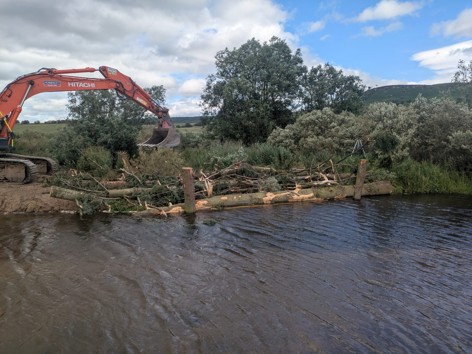
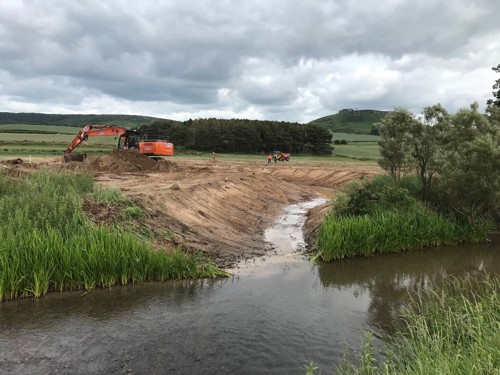
Philip continued: “To achieve our aims, we identified the original path of the river through a series of topographical and Light Detection and Ranging (LiDAR) surveys. Then the flood bank was breached at a number of locations and the team dug a new, deliberately undersized river channel adjacent to river’s old channel. As the old river channel had eroded downwards and been dredged over the years, the bed levels were much lower than floodplain, so a series of timber dams were installed to help raise water levels upstream and push the water out into the new channels. In addition to this, we worked to capture surface flows and store this on the floodplain, creating wet areas and filtering run off to improve water quality.”
Environmental concerns
The River Breamish is a both a Site of Special Scientific Interest (SSSI) and a Special Area of Conservation (SAC). As such, it has a number of notifiable (and protected) species including Atlantic Salmon, 3 species of Lamprey (brook, sea and river) and Otter. The environmental concerns added another unique element to the project’s delivery.
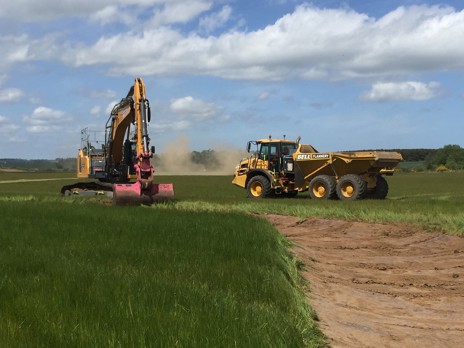
Philip said: “We had to undertake rigorous environmental surveys during design phase to identify habitats plus protected species and then take cognisance of these during design and construction phase of works. Given the nature of the work, an extensive Construction Environment Management Plan (CEMP) was created by the specialist contractor and adhered to during the construction works.
We were also required to work within a fixed ‘in river working window’ agreed with the River Tweed Commissioners and the Environment Agency. This was to prevent any disturbance of migratory Salmon and Sea trout during autumn or disturbance and destruction of areas of river where fish have spawned. Allied to this, we had to minimise risk of disturbance to nesting birds during the nesting season. We initially surveyed and identified key potential nesting areas for Sand Martins and where necessary, made these areas unavailable for nesting purposes to prevent delays to work. For all other areas, advance nesting bird checks were programmed and undertaken 24-48 hours in advance of work by an Ecological Clerk of Works (ECoW) to ensure the absence of nesting birds. Additional time had been built into the works programme to allow for delays relating to this.”
With such complexity, positive collaboration was crucial to the project’s success. The project was developed over 10 plus years by the River Till Restoration Partnership (made up primarily of Environment Agency, Natural England and Tweed Forum). The partnership and wide ranging skill sets allowed for the development and prioritisation of a range of projects against the strategy and seeking of funding and permissions to allow projects to be delivered.
Philip said: “The partnership formed the framework that allowed us to bring in additional technical resources where required, like designers, ECoW or similar. During the design and development process of this project, we engaged with specialist contractor Ebsford Environmental as Early Supplier Engagement, to help refine designs and inform agreed process to assist with securing planning permission and a Flood Risk Activity Permit (FRAP) for the scheme.”
Lessons for other projects
As one of the UK's largest restoration efforts, it serves as a model for future nature recovery projects. Philip offered several lessons he learned from the project and pieces of wisdom that other project professionals can take from his experience:
• Expect the unexpected. Modelling and planning are usually correct but rivers are dynamic systems, so expect some change.
• Do not underestimate the volume of ecological surveys required and the time these require in the programme. Allow extra time if licences or preparatory work is required. Given the overlapping demands of a fixed in river working period, nesting season and impacts on other protected species, a small delay can easily lead to a delay of 6+ months to the next working window.
• Allow a lot of time to secure all necessary permissions – planning permission, FRAP, Water Resource Permits etc. All of these need to be in place prior to starting.
• We were incredibly fortunate in having a very dry year and low water levels, this allowed us to finish 3-4 weeks ahead of schedule but you need to allow float in the programme to account for weather – even in the summer.
•Having an appropriately experienced and skilled contractor is essential. This is sensitive environmental work and not standard civil engineering.
• Work with the landowner, understand their business requirements and work to a design which enhances both. Having a supportive landowner is critical to project success.
• Having the right project team is critical. You need restoration designers, geomorphologists and engineers who understand natural processes and will work to replicate those.
1 comments
Log in to post a comment, or create an account if you don't have one already.
I really enjoyed this case study. Reading it from the perspective of someone working in a different industry made it even more interesting. It reinforced the importance of not underestimating timelines and building in enough flexibility from the start. It also reminded me how crucial it is to identify not just the obvious stakeholders, but also those indirectly impacted, ensuring their requirements are considered early and reflected in delivery. Most of all, it highlighted the need to stay prepared for the unexpected and have a clear strategy to maintain momentum when challenges arise.