
Project politics and the art of the possible

Politics can be frustrating and is often counterproductive. But the solution to squabbles, power-plays and conflicting agendas isn’t to dismiss politics; it’s to understand it, then use it to further project goals.
“There is a genuine power in understanding the politics happening around us, without letting it distract and eat up our time,” explained Nukey Proctor, Senior Project Director at transformation consultancy Methods, in a blog for APM.
Her recommendations (drawn from her book, How to Manage Project Politics) remain a go-to guide for APM members:
- Use the power of insight: We consider thorough research crucial to inform budgets, timelines and resource requirements; and to reveal stakeholder relationships, preferences and motivations.
- Evaluate emotions: It’s easy to run into political problems if you’re not sensitive to other people’s emotions (and your own), especially when the project is under pressure.
- Focus on the outcomes: If a project’s ultimate benefits, target end state or even its stage gates aren’t crystal clear to everyone, there’s room for opinions and agendas to creep in.
- Manage conflict healthily: Never assume there won’t be fights, no matter how well you plan. Instead, work on the project culture and its forums to encourage calm approaches to disagreements that allow people to be frank and open (especially about failures) without blame. Nukey recommends the Thomas-Kilmann Conflict Mode Instrument (shown below).
- The right person at the right level: Nukey says the ‘who’ is as important as the ‘what’. When politics intrudes, knowing who can bring parties together (or assert control) to resolve an impasse is crucial.
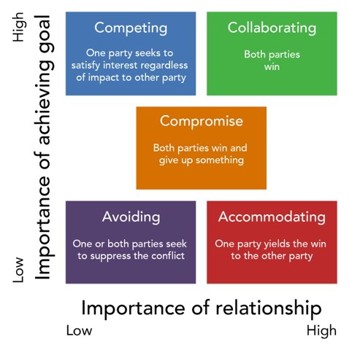
All Nukey’s points are a reminder that while the right tools, targets, processes and disciplines can provide real clarity to a project, one of the biggest wins they deliver is an environment where human interactions can flourish towards beneficial outcomes.
Here are some other useful ways to manage politics well:
1. An enterprise approach
Leaders should utilise delivery models that focus on bringing partners into an integrated, collaborative team where shared outcomes take precedence over the measurement of inputs. Treat short-term metrics as informative, not as targets.
2. The right tool for the job
Select the right person for the specific phase of the project, regardless of their parent organisation; expertise, rather than corporate loyalty, drives delivery.
3. Psychological safety
Ensure staff feel safe to voice opinions, challenge decisions and admit mistakes without fear. This helps prevent a ‘good news culture’ where poisonous politics thrives.
“The real test is conversion: turning divergence into stronger alignment around better decisions,” explains governance expert Roger Chao. “Leaders often mistake ‘discussion’ for ‘conversion’. Yet dissent that is not converted becomes either residue (corridor doubt) or sabotage (quiet non-commitment).”
(When we talk about the ‘corridors of power’, it’s useful to think of them as literal corridors – those casual ‘offline’ chats are where bad politics takes root…)
4. Outcome-based incentives
Incentivised contracts should align the whole supply chain to a framework of outcomes that create value for all stakeholders. In Project journal’s winter 2025 issue, several leaders on the Elizabeth Tower refurb lauded the NEC Engineering and Construction Contracts. “[They] help get those tricky budget and scope conversations out into the open in real time, so everyone is clear on the risks, implications and ways forward,” said project manager Gordon Phillips.
5. ‘Honest broker’ governance
On bigger projects, a programme board with independent members can provide a neutral forum for problem-solving and conflict resolution, acting as a buffer against internal power struggles.
6. Clear accountabilities
Explicit roles and responsibilities from the outset ensure accountability is not spread too thinly, preventing departments from pitting themselves against one another when challenges arise.
Acknowledging biases
APM has returned to the topic of politics with its recently published book The Impact of Politics on Project Success in Multi-Agent Projects, written by Amos P Haniff, Laura Galloway and Isabel M Gillert. The authors’ focus was government projects, and interviews with 30 experienced project leaders in the field revealed the additional challenges of working inside ‘big P’ politics.
The issues are much the same – but the implications (and publicity) attached to those wider political objectives clearly complicate matters.
“We’re not going to expect people to hand off their political considerations or even their biases,” Prof Haniff told us. “But we need to acknowledge what they are in order to fit them within a constructive project framework.”
You may also be interested in:

Richard Young is the consulting editor of Project.
Project is the official journal of the Association for Project Management (APM).
0 comments
Log in to post a comment, or create an account if you don't have one already.