
WiPM 2026: How to use your voice and be heard

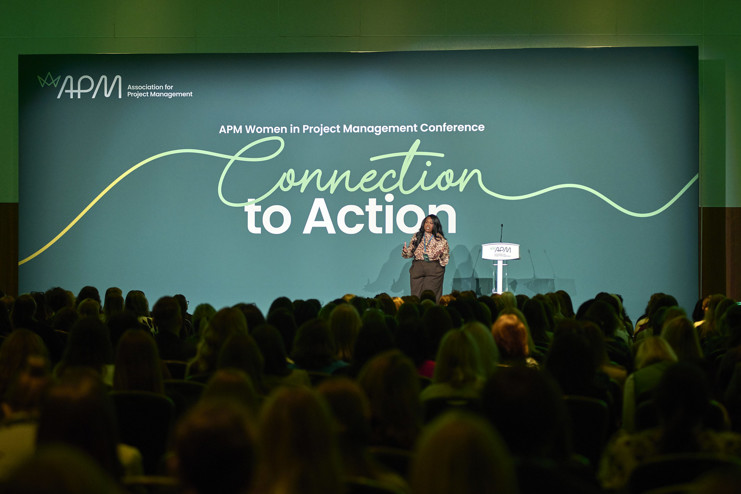
How can project professionals speak up, connect with others and communicate with greater impact? Emma De Vita reports on the APM Women in Project Management Conference, where speakers shared practical ways to build emotional audacity, strengthen your presence and make your voice heard.
Another year, another packed APM Women in Project Management Conference. If you weren’t lucky enough to be there, then you need to know that one important theme of the day was how to use your voice to make better connections.
Four challenges were set out for attendees to discuss:
- Delivery and wellbeing: communicating across cultures and balancing demanding timelines with people’s needs.
- Ambiguity and invisible work: turning unclear direction into clarity and bridging gaps when nobody else takes responsibility.
- Authority and perceptions: challenging decisions while navigating how women’s assertiveness is received.
- Being heard, included and recognised: getting space to contribute in meetings, receiving credit for ideas, being included in informal conversations and finding allies who advocate for you.
Become emotionally audacious
Opening keynote speaker Shola Kaye, who helps organisations use communication to prepare for the future, shared why it’s necessary to cultivate your ‘emotional audacity’ and explained how to do this well to make stronger connections. Emotional audacity means having the courage to speak up, use your voice and ask for what you need, based on what your feelings and emotional intelligence are telling you.
“We often spend time wondering if we should be taking action, and if so, what action we should take. When good people are second guessing themselves, that’s energy going to waste. Great ideas are held back, decisions and resolution are delayed, and confidence gets dented because you’re not taking action,” she explained.
During periods of uncertainty, often we will turn to artificial intelligence (AI).
“When it comes to human behaviour and how we should connect with each other, AI may give us options, but it doesn’t have real empathy and it’s very sycophantic. So instead of telling you the tough thing you need to do – that you need to have courage and the audacity to step up – it will give you the easy option,” Kaye warned. “Our feelings are very valuable data, and we need to not discount them.”
Three things to always consider
When you make an important decision, Kaye said, you need to take three things into account: your feelings, the feelings of those around you and the wider environment, whether that’s your team or the organisation. If you don’t have all three balanced, then problems will occur.
For example, if you don’t take your own feelings into account, you might become over-accommodating of other people, face burnout because you are trying to please too many people and feel resentful because you feel you are not being considered by others. When you fail to consider others, you might be perceived as blunt, abrasive, defensive or untrustworthy. Finally, if you fail to think about the environment in which you’re operating, then you are in danger of speaking up at the wrong time, having good ideas land badly or behaving in a reckless way that might damage the team or the organisation.
Better decisions happen if all three aspects are considered, but connection comes first, Kaye said. She gave three tools to help you connect with empathy:
- Create a personal user manual that can be shared with the team. What are your ideal work conditions? What is your absolute requirement to do great work? Which are your preferred communication channels? How do you like to receive feedback? Set out what your strengths are, what you struggle with and what you’d like the team to know about you. Make sharing this document something fun, quick and easy to implement. Share it not only at the beginning of a project, but throughout as conditions and requirements change.
- Use the ‘presumptive ask’. This is a way of asking for what you want by asking someone what they need in order to give you what you need. For example, if you are struggling with stakeholder engagement, instead of demanding more information from someone, ask them what they need in order to meet your deadline. This allows them to co-create a solution with you, explained Kaye. “They are helping you rather than blocking you… You are asking someone to share a bit of their world with you. It’s super powerful.”
- Small talk versus big talk. Engage people at a deeper level for a stronger connection by simply asking them about their feelings. “If you really want to connect, ask for their opinion and thoughts on something, rather than just data,” said Kaye. “We can turn small talk into big talk. Instead of asking, ‘How are you?’, ask, ‘How are you feeling?’ Instead of saying ‘It’s great, isn’t it?’, ask, ‘What’s your opinion on it?’”
“A way to bring all of this together is to think about the three Fs: feel, filter and follow-through,” advised Kaye. “What am I feeling? What happens if I filter [my feelings] through the self, other and environment lenses?” Before your next important conversation, think about self (what am I bringing?), other (what might I be missing?) and environment (what’s really going on here?).
“Then choose the best and wisest action, not simply the easiest one,” said Kaye.
The art of building allies
In your quest to deliver a successful project, you can build connections by accumulating allies who will advocate for you along the way. In a session dedicated to sharing advice on how to do this well, Sarah Ridder, Head of PMO at the UK Atomic Energy Authority, was joined by Chucks Onyekwelu, Project Delivery Manager at Vodafone; Sarah Martindale, Senior Project Manager at WSP; and Aasha Marenghi, Director of Subsea Project Management at BP. The focus was on exploring how building authentic professional relationships can strengthen your influence, help gain support for your ideas and improve project outcomes.
“The people who I built relationships with in the early stages of my career have now progressed up and out around the organisation… And those relationships don’t stop; they continue,” said Marenghi. “Your network starts to grow through those relationships and relationships that they have with others. The beauty of those relationships is that when they’re with the people who work closely with you, they really see who you are and how you operate, and can then advocate for you, knowing what your style is.”
Networking doesn’t have to be a clinical exercise – you can take a natural approach that is more about building friendships and making personal connections.
“My perception of networking, up until quite recently, was that you have to walk the room, be extroverted and get as many people as you can on your LinkedIn,” she added. “But it is much more about that personal human connection and trusted relationships.”
Human connection is what matters
It can pay to step away from your device to make human connections. Onyekwelu said: “In my line of work, it’s all about telecommunications, emails, building sites, and sometimes, you take a pause, you talk to people, you meet up for coffee… Just build that connection, speak past the football conversations – people have more intimate things to share with one another.”
Martindale spoke of the benefits that allyship brings: “It’s about others opening doors for you that you can’t necessarily see yourself or don’t think that you’re good enough for.” It also means you get to help others by using your network for the benefit of somebody else, by connecting them with people who can help solve their problem. “I was just the glue, and sometimes, it’s a hidden thing that we do.”
By taking the trouble to get to know the people you work alongside, you’re then able to better serve the projects you work on. Marenghi said: “I have a global organisation of project managers and project engineers, and it’s about putting them in the right places on the right projects to serve the needs of the business – and knowing them well enough to identify opportunities for them.”
Top practical tips
The panellists gave practical advice for those wanting to build their network of allies. Try making your own ‘boardroom’ of allies, where you map who is supporting you, who your sponsor and advocates are, and the peers who motivate you towards bigger and better things.
Take time to think about your professional reputation: what do you want people to say about you when you are not in the room? Let your work be your trademark so that you have allies advocating for you when you’re not present. Regularly review your network: is it still working for you, or is there somebody or something missing? While it’s tempting, don’t just include ‘yes’ people. Make sure you have someone in your inner circle who will challenge you or who doesn’t necessarily agree with your mindset or approach. They might be able to open up a new way of thinking for you.
Finally, remember that your network doesn’t just have to come from within your organisation. You can find many allies outside – as those who came along to the APM Women in Project Management Conference discovered.
Find out more about the APM Women in Project Management Interest Network here.
This is a free Project article. Browse more articles here. Not a paying member? Join today

Emma De Vita is editor of Project, the official magazine of the APM that’s available to all paying members.
0 comments
Log in to post a comment, or create an account if you don't have one already.