
Would you as a project manager like to be able to deliver successful projects more often and more consistently? This would certainly have it's advantages both for your own career and for the reputation of your organisation...

A project life cycle is a framework comprising a set of distinct high-level stages required to transform an idea of concept into reality in an orderly and efficient manner.
Life cycles offer a systematic and organised way to undertake project-based work and can be viewed as the structure underpinning deployment.
Definition from APM Body of Knowledge 8th edition

Life cycles are fundamental to the management of project¬-work: Different approaches can be util¬ised for deployment, depending on the desired outputs, benefits and outcomes and the expected uncertainty, novelty and risk appetite. The choice of deployment approach will play a key part in selecting the most suitable form of life cycle.
Linear (waterfall) life cycles are sequenced into a set of distinct phases, from the development of the initial concept to the deployment of an ultimate outcome, output or benefits. This approach aims to be highly structured, predictable and stable.
Iterative (agile) life cycles are composed of several iterations, which repeat one or more of the phases before proceeding to the next one. Iterative approaches can only proceed when user feedback is available to be used as the basis for initiating new cycles of development, refinement and improvement.
Hybrid life cycles typically fuse together elements to create a new model or approach. For example, utilising iterative or agile methods for early requirements gathering, where the uncertainty is greatest, and following it up with incremental or sequential processes to formalise deployment. Other types of life cycle include:
There is no universal best approach. Project professionals select the most suitable arrangement for their context, most often combining features from any of the above into a hybrid life cycle.
Extended life cycles add adoption and benefits realisation phases to the end of a standard project life cycle. This provides project professionals with the accountability and additional investment to ensure that changes are fully embedded into business operations and the anticipated benefits of the project are realised. Extended life cycle includes:
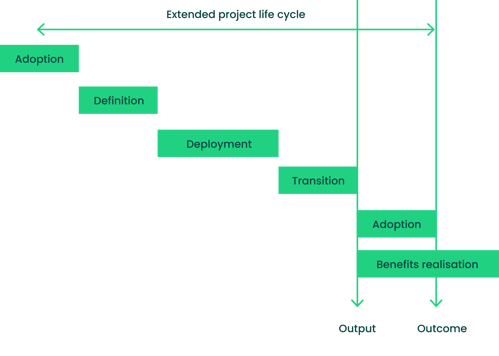
Linear project life cycle
Source: APM Body of Knowledge 8th Edition
Project professionals play a fundamental role in incorporating sustainability throughout the project life cycle.
Concept:
Understand the project's sustainability context by considering relevant legislation, policies, best practices, opportunities and risks. Sustainability and regenerative objectives should be aligned with organisational strategies and incorporated into the business case, options analysis and decision-making, taking account of environmental, social and natural capital impacts.
Definition:
Define how sustainability outcomes will be achieved, measured and monitored through benefits management and KPIs. Ensure the project team has the necessary skills and expertise, undertake relevant sustainability assessments, and embed sustainability principles into governance, decision-making and project processes.
Deployment:
Deliver sustainability objectives by working with suppliers whose credentials and solutions align with project goals. Manage sustainability-related opportunities and risks, remain open to more sustainable alternatives as they emerge, maintain stakeholder engagement, and monitor environmental and social performance throughout delivery.
Transition:
Ensure sustainability outcomes are embedded into operations through a structured handover plan. Evaluate environmental and social performance, pursue sustainability certifications where appropriate, and communicate outcomes and achievements to stakeholders.
Monitoring post-project sustainability and regenerative performance should be maintained throughout the adoption phase to track the ongoing impact of the project. Lessons learned and opportunities for continuous improvement should be documented and shared for future projects.
Learn more about sustainability in project management.
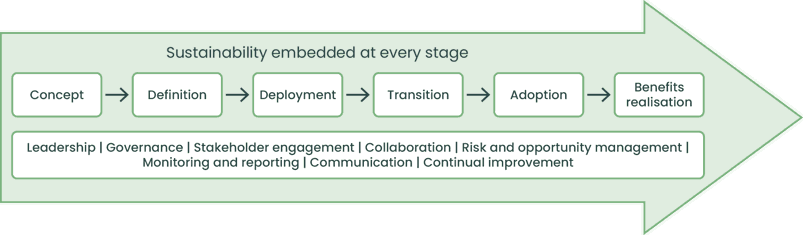
Embedding sustainability at every stage of the project
Source: APM Body of Knowledge 8th Edition
An overview of the different types of project life cycle options.
Explore the resources in this interactive module to learn about different life cycle approaches and discover which one might be right for your projects. Linear, iterative, hybrid, agile or waterfall - which is most appropriate for your project?
APM Learning is only available to fee paying individual members
and Honorary Fellows.
Would you as a project manager like to be able to deliver successful projects more often and more consistently? This would certainly have it's advantages both for your own career and for the reputation of your organisation...

“Developing a project management department has been an excellent learning curve, it has made much more sense than attempting to move forward without a project management department.”

Have you ever thought about what your next project might bring in terms of management challenges? Could these be different in a hybrid project? Would you be able to recognise and prepare for any differences ahead of time?


This edition offers a fully refreshed, comprehensive and holistic view of the programme life cycle. It integrates the people, processes, governance, assurance and benefits considerations into a single, accessible guide. It examines emerging technologies, hybrid working, sustainability and modern risk practices.
The guide supports experienced assurance professionals who may be undertaking assurance of their first agile project and shows how undertaking traditional assurance reviews can be adapted to ensure assurance activity of agile projects is both effective and valuable.
The effective operation of assurance provision and use of assurance information are essential to the reliable delivery of successful projects. Assurance is an essential element of project management, working closely with governance and risk management in a mutual supportive arrangement.
The APM Body of Knowledge is a foundational resource providing the concepts, functions and activities that make up professional project management. It reflects the developing profession, recognising project-based working at all levels, and across all sectors for influencers, decision makers, project professionals and their teams.


With the APM Learning portal members can unlock over £4,000 of professional value from 70+ hours of expert-led learning, guides, tools and templates.

Browse our popular project management 'What is ...?' topics for definitions, quick insights, view related case studies, research, blogs and glossary.

Project – APM's official magazine, available exclusively to paying members. Project covers the latest news, opinions and insights for those in the project community.

The APM Community is our online community platform that connects our members faster and easier than ever before.