
The multi-generational project team isn’t a challenge: It’s a leadership opportunity

Walk into almost any project or programme environment in the UK today and you will see it straight away: early‑career graduates working alongside colleagues with 30+ years’ experience. This may have been uncommon in the past but isn’t unusual anymore. It’s the norm. Soon, there’ll be no need to say “multi-generational team”, as simply “team” will suffice.
Many organisations now have four or even five generations working together, spanning more than 50 years of age and experience. Yet often this is still framed as a problem to manage, as though generational difference is inherently a source of friction. However, generational diversity is not a challenge to overcome, but a leadership opportunity we should embrace.
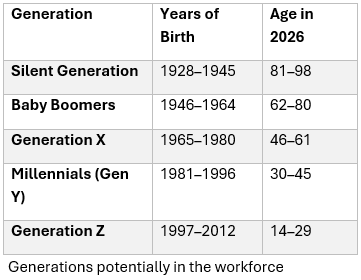
Generational diversity is the new norm
Why are we seeing greater generational diversity?
People are working for longer, career pathways are not as linear, retirement patterns are changing and organisations are placing early-career talent into delivery environments much earlier. As a result, age-diverse teams are no longer an exception. Instead, they are part of the environment in which modern projects are delivered.
The issue therefore is not that people of different generations are working together. It is whether leaders can create the conditions in which different experiences, assumptions and ways of working can contribute to better outcomes.
This distinction matters. If generational diversity is treated as a problem, leaders are likely to search for ways to minimise difference. If treated as a source of value the focus shifts to how difference can be surfaced, understood and applied.
Research clearly shows us value is created from difference, and diverse teams improve outcomes by bringing a wider range of perspectives.
So, the question isn’t “How do we overcome generational differences?” It’s “How good are we at leading diverse teams?”
The myth of the “generation gap”
The so-called “generation gap” in the workplace is the result of miscommunication and misunderstanding, fuelled by stereotypes.
- “Boomers don’t understand technology.”
- “Gen Z don’t want to work.”
- “Millennials need constant feedback.”
However, the evidence tells a different story. Research shows that people across generations share many of the same core motivations: doing meaningful work, learning, feeling valued and progressing in their careers. Differences may exist but are rarely explained by age alone.
When leaders lean too heavily on generational labels, they risk creating the very problems they’re trying to avoid. The label becomes louder than the individual.
Where leadership shows
Managing a mixed-age team isn’t about balancing competing groups; it’s about creating the right conditions where different strengths can work together.
Research consistently points to the same factor when reviewing performance of multigenerational teams: leadership.
There are measurable benefits to getting leadership right in multi-generational teams. Studies show that cross-generational collaboration can improve engagement and retention, while inclusive practices unlock productivity gains. In short, teams perform better when leaders create inclusive environments where different perspectives are heard.
So generational diversity isn’t a risk to manage - it’s a performance lever.
What can leaders do to maximise the opportunity
Here are some practical ways leaders within project and programme environments can pull that performance lever:
1. Stop leading generations, start leading individuals
Generational frameworks can be useful, but they should never replace understanding the individual. Strong leaders avoid assumptions based on age or generation and focus instead on individual strengths, preferences and motivations. They create space for people to define how they work best rather than expecting them to fall in line with the stereotypes.
2. Intentional communication design
Different people prefer different ways of working. That’s not a problem, it just needs to be managed. Leaders should agree on team communication norms early (meetings, chat, email), review them often and be open to mixing formats to suit different preferences. This reduces friction and builds trust quickly.
3. Use difference as an asset in decision-making
Age diversity brings knowledge diversity. Experienced colleagues may recognise patterns, risks and stakeholder dynamics. Early career colleagues may question assumptions that have become normalised. Good leaders invite respectful challenge, avoid defaulting to the loudest or most senior voice and create space for contribution before decisions are fixed.
4. Build two-way learning into the team
One of the biggest missed opportunities in multi-generational teams can be knowledge sharing. Mentoring should involve knowledge moving in both directions. Older colleagues may share delivery judgement whereas younger colleagues may bring new tools and a different approach to problems. Learning should be part of everyday delivery. Leaders can encourage this by pairing people for reverse mentoring and creating other informal learning mechanisms within the team.
5. Create psychological safety across the mix of generations and seniority
People won’t share ideas if they feel judged or dismissed. Junior colleagues may avoid challenging senior voices and senior colleagues may disengage if they feel undervalued. Different communication styles may be misread as resistance or lack of confidence.
Leaders should:
- Actively invite input from everyone
- Normalise different ways of contributing
- Create a safe space to challenge and fail.
Not just in words but in everything you do as a leader. This is where inclusion moves from principle to practice.
A shift in mindset
We often talk about “managing” generational diversity as if it’s something to control and overcome. However, the reality is it’s full of potential. Generational diversity is becoming the norm and is still increasing. The difference between teams that struggle and teams that thrive isn’t age, it’s leadership.
A multi-generational team can bring different histories, expectations and approaches to the work. Left unmanaged, this can create misunderstanding. Led well, it can strengthen decision-making, improve learning and increase resilience.
So, the next time generational differences come up as a “challenge”, it’s worth pausing and reframing. This isn’t about overcoming a problem, it’s about the opportunity to unlock the full strength of a truly diverse team.
You may also be interested in:
- What is diversity and inclusion in project management?
- Attend the APM Women in Project Management Conference
- Foundations of Diversity and Inclusion in Project Management Book one
- Continue the conversation over at the Community
- Explore a free taster of APM Learning's new module on multigenerational working in projects

Sophie Cattermole is a Managing Consultant at BMT with over 12 years’ experience delivering P3M and business change across complex UK Defence programmes. She holds an MSc in Occupational Psychology and combines technical delivery with a strong focus on people, behaviour and inclusive ways of working. Sophie is also a volunteer with the APM’s People Interest Network."
0 comments
Log in to post a comment, or create an account if you don't have one already.